1. Home
  2. blog
  3. what claude design could mean for UX
Digital Marketing

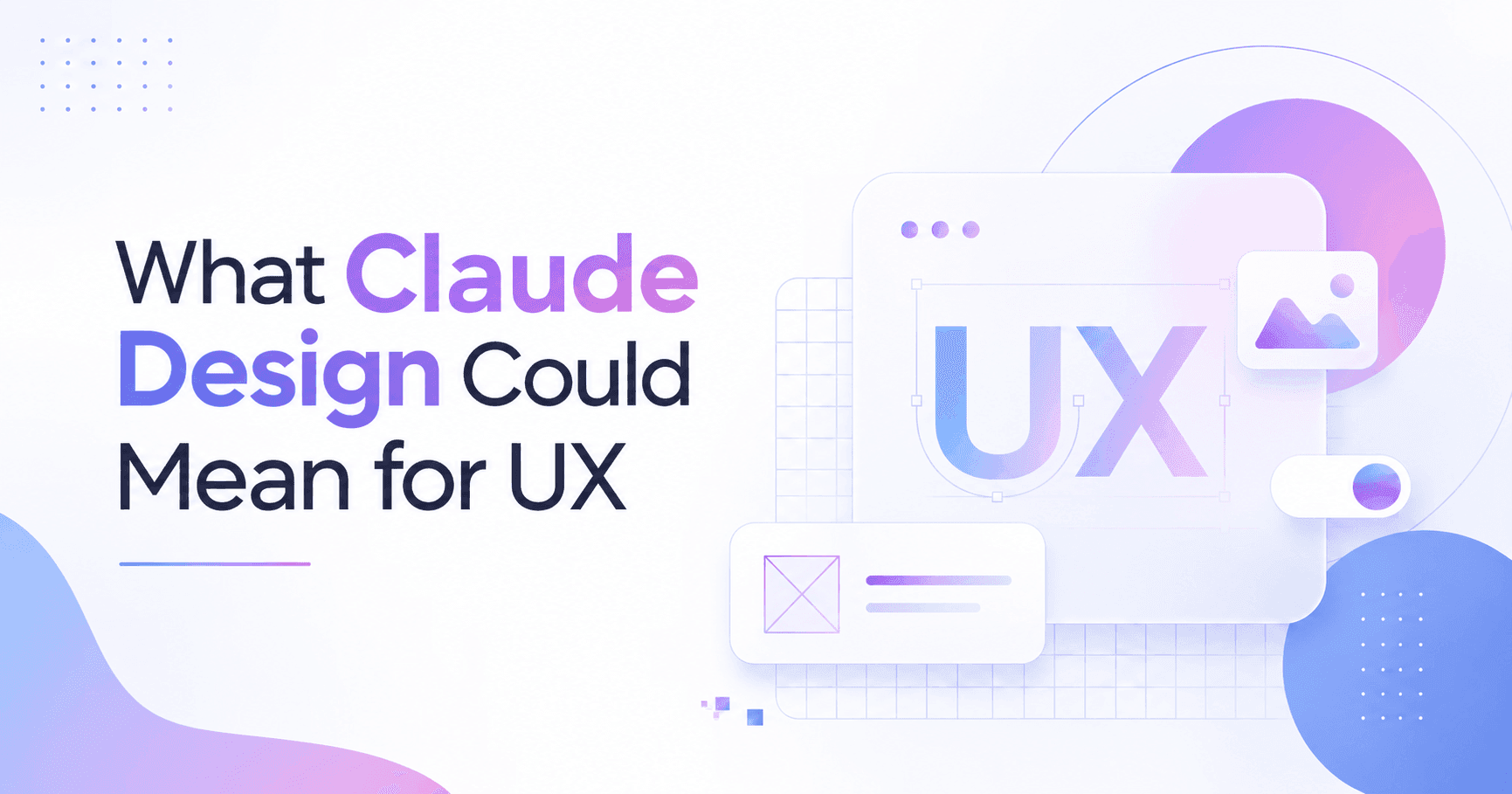
What Claude Design Could Mean for UX

From prompt to prototype, in one conversation: A tool that turns a sentence into a working prototype doesn't just change how fast designs get made — it changes who gets to make the first decision about how something should feel. That's the real UX story buried under the Figma-competitor headlines.

Zaheer Shaikh
Zaheer Shaikh
SEO Manager
August 29th, 2026
47 views
What Claude Design Could Mean for UX

A tool that turns a sentence into a working prototype doesn't just change how fast designs get made — it changes who gets to make the first decision about how something should feel. That's the real UX story buried under the Figma-competitor headlines.

Quick Answer

Claude Design could shift UX work earlier and cheaper: founders and PMs can produce testable prototypes without a design queue, designers can explore more directions before committing, and brand-consistent drafts can reach users faster. The trade-off is that speed without a human filtering for taste and user need risks flooding products with plausible-looking, poorly-judged interfaces.

On this page

  1. What is Claude Design, exactly?
  2. 7 ways it could reshape the UX workflow
  3. Claude Design vs. traditional design tools
  4. Where this could go wrong
  5. A checklist for teams testing it
  6. FAQ

What Is Claude Design, Exactly?

Claude Design is Anthropic's conversational design product, launched under Anthropic Labs and built on the Opus 4.7 model's vision capabilities. You describe what you need — a landing page, a feature flow, a pitch deck — and Claude produces an initial visual draft. From there you refine it through comments, direct edits, chat, or sliders Claude generates on the fly, rather than manually pushing pixels.

The distinguishing move is that it can pull in a team's actual design system: brand colors, typography, and components sourced from existing design files, a codebase, or even a live capture of the company website. Once a design is ready, it can be packaged into a handoff bundle for Claude Code, or exported to PDF, PPTX, standalone HTML, or Canva. It's currently a research preview available to Claude Pro, Max, Team, and Enterprise subscribers.

7 Ways It Could Reshape the UX Workflow

1

Closing the brief-to-mockup gap

Ideas that used to sit in a backlog for a design cycle can become a clickable draft in one conversation, so a PM or founder can react to something real instead of a written spec.

2

Turning static screens into testable flows

Mockups can become interactive prototypes without a code review or a pull request, which means user testing can start days earlier in the process.

3

Brand consistency without a style guide lookup

Because Claude can read a team's existing files and site, drafts start closer to on-brand instead of needing a full pass to fix fonts, colors, and spacing.

4

Making exploration cheap again

Trying five directions instead of one usually gets cut for time. When a variation costs one prompt, teams can afford to compare more before committing.

5

Shortening the design-to-code loop

A finished design can move straight into Claude Code as a handoff bundle, cutting out the usual re-interpretation gap between what was designed and what gets built.

6

Pushing designers toward judgment over production

If drafting gets automated, the value a designer adds shifts toward deciding what's right for the user — editing and taste matter more than manual execution speed.

7

Letting non-designers shape the first draft

Founders, marketers, and PMs without design training can now produce a first pass themselves, changing who gets the first say in how a product looks and feels.

Claude Design vs. Traditional Design Tools

Dimension Claude Design Traditional tools (e.g. Figma)
Starting point A text prompt, document, or codebase A blank canvas or existing file
Speed to first draft Minutes, via conversation Hours to days of manual work
Best suited for Early exploration, prototypes, decks, one-pagers Detailed, componentized design systems at scale
Handoff to engineering Direct bundle to Claude Code, or export to PDF/PPTX/HTML/Canva Dev handoff via specs, tokens, and manual inspection
Learning curve Conversational, low barrier for non-designers Steeper, tool-specific expertise required
Where it currently falls short Fine-grained, pixel-level design-system control Not built for one-prompt speed on first drafts

Where This Could Go Wrong

Common mistakes to watch for

The risk isn't the tool — it's what teams do with the speed it creates. A few patterns worth guarding against as UX teams start experimenting:

  • Shipping the first plausible draft instead of testing it against real user behavior.
  • Letting an AI-generated "house style" flatten a brand's genuine visual identity over time.
  • Treating a fast prototype as validated research, when it's only ever a starting point for one.
  • Skipping designer review because a draft already looks finished.

A Checklist for UX Teams Testing Claude Design

  • Point it at your real design system files or brand site before generating anything, so drafts start on-brand.
  • Run the same brief through 2–3 prompt variations before picking a direction to keep exploration honest.
  • Put every prototype in front of an actual user before treating it as a decision, not just a demo.
  • Keep a designer in the review loop even when a draft looks finished — polish isn't the same as correctness.
  • Track which handoffs go to Claude Code vs. Canva vs. a human designer, and note where each worked best.
  • Revisit access and usage limits periodically, since this is still a research preview and terms can shift.

Frequently Asked Questions

Is Claude Design meant to replace Figma?

Not for production design systems. Claude Design is built for the early, messy part of the process — turning a prompt or a brief into a first draft, a wireframe, or a testable prototype. Figma and similar tools still own the detailed, componentized design-system work that ships to engineering at scale.

Who can access Claude Design right now?

It launched as a research preview for Claude Pro, Max, Team, and Enterprise subscribers, reachable from claude.ai. Enterprise organizations need an admin to switch it on before members can use it. Availability and limits can change, so it's worth checking Anthropic's current documentation before planning a workflow around it.

Can Claude Design output go straight to developers?

Yes, that is one of its core moves. A finished design can be packaged into a handoff bundle and passed to Claude Code in one step, and it also exports to PDF, PPTX, standalone HTML, or over to Canva for teams that prefer a traditional next step.

Does it work with a team's existing brand and design system?

It's designed to. Teams can point it at their design files, codebase, or brand website using a web-capture tool, and it will pull in colors, typography, and components so new work stays visually consistent with what already exists.

What's the biggest UX risk with a tool like this?

Speed without judgment. When a first draft costs one prompt instead of a day, teams can start shipping whatever comes out fastest rather than what's actually right for the user. The tool removes production friction, not the need for a human to decide what's worth building.

Want your product's UX audited with this lens?

We help teams turn AI-accelerated design drafts into interfaces users actually stick with — let's talk.

Let's Build Something Bold

Our Clients

Trusted by 2500+ businesses for innovative website design & development solutions.

Logo
Logo
Logo
Logo
Logo
Logo
Logo
Logo

Our Services

  • Brand, Content & Influencer Strategy→
  • UI UX, Web & Custom Tech Solutions→
  • Full-Funnel Marketing→
  • Digital Strategy & Consulting→
  • E-Commerce & Business Evolution→
  • AI, Automation Tech→

Latest Posts

GEO by Engine: How ChatGPT, Claude, Gemini, and Perplexity Choose What to Show

Generative AI has changed how people search for information. Instead of typing a short keyword into Google and opening several websites, users can now ask complete questions to platforms such as ChatGPT, Claude, Gemini, and Perplexity and receive a conversational answer within seconds. That creates a new challenge for businesses. Ranking on Google is still important, but brands also need to understand how their content can become visible, referenced, mentioned, and cited inside AI-generated answers. This is where Generative Engine Optimization (GEO) becomes important. However, there is one major misconception: there is no universal GEO formula that works identically across every AI platform. ChatGPT, Claude, Gemini, and Perplexity have different products, retrieval systems, data sources, and ways of presenting information. Their exact ranking and selection mechanisms are proprietary, so nobody outside the companies operating these systems can provide a complete formula. What marketers can do is study their publicly documented capabilities, observable behaviour, search experiences, and content requirements — then build content that is useful across these different environments. In this guide, we will break down how GEO differs across ChatGPT, Claude, Gemini, and Perplexity, what businesses should focus on, and how traditional SEO fits into the AI-search era.

Zaheer ShaikhSep 30, 202610

Meta Tags for SEO: What They Are, Why They Matter, and How to Use Them Right

Meta tags are small pieces of information added to a webpage's HTML that help search engines, browsers and other platforms understand or process the page. Some metadata can influence how a page is indexed or represented in Google Search, while other elements mainly affect how the page appears when shared on social platforms. For modern SEO, meta tags should not be treated as a ranking shortcut. A strong SEO strategy combines metadata with useful content, technical accessibility, internal linking, site structure, page experience and search intent. In this guide, we will explain the most important meta tags and related HTML elements, what each one does, how to optimise them, common mistakes to avoid, and how metadata fits into modern SEO and AI-powered search.

Zaheer ShaikhSep 16, 202653

Google Search Algorithm Changes: The 2026 Complete Q&A Guide

Google updates its search algorithm thousands of times each year, but major core updates can significantly impact website rankings and organic traffic. This complete 2026 Q&A guide explains how Google algorithm changes work, what factors influence rankings, how AI and user experience affect search visibility, and what website owners can do to stay compliant with Google's best practices. Discover expert insights, recovery tips, and future SEO trends to help your website maintain strong search performance.

Zaheer ShaikhJul 30, 202668

Get In Touch

logologo
View Portfolio
logologo

Connect on Social Media

Instagram - Nexgeno
Overview
  • About Us
  • Certifications
  • SSL Certificates
  • DevMethodology
  • Career
  • Contact
Insights
  • Our Clients
  • FAQ
  • Blog
Our Work
  • Testimonial
  • Casestudy
  • Portfolio
Services
  • Website Maintenance
  • SSL Certificates
  • Top SEO Company in Mumbai
  • Social Networking
  • AI/ML Development
  • Mobile App Development
  • Cloud Solutions Services
  • E-Commerce Website
  • Product Prototyping
  • Front-end Development
  • Digital Transformation
  • Custom Website Designing
  • Search Engine Optimization
  • Application Development
  • Website Development
  • Website Designing
Solutions
  • Multi Restaurant Management
  • Online Food Ordering System
  • Hotel Booking System
  • Chat Application
  • Lawyer Booking
  • Job Portal
  • Hospital
  • HRMS Payroll System
  • Car Rental System
  • POS
  • Billing Application
  • CRM Application
  • Recruitment Billing Application
  • Tailor Billing Application
  • School Management
Hire Developer
  • Hire Vue Js Developer
  • Hire Next Js Developer
  • Hire WordPress Developer
  • Hire OpenCart Developer
  • Hire Magento Developer
  • Hire Shopify Developer
  • Hire React JS Developers
  • Hire Angular Developers
  • Hire PWA Developers
  • Hire React Native Developers
  • Hire Lonic Developers
  • Hire Flutter Developers
  • Hire Android App Developers
  • Hire iOS App Developers
  • Hire Express JS Developers
  • Hire CodeIgniter Developers
  • Hire Laravel Developers
  • Hire PHP Developers
Industries
  • Hospitals
  • Service Provider
  • Tours & Travel
  • Pharmaceutical
  • Health Care
  • Real Estate
  • Recruitment
  • Manufacturing
  • Logistics & Distribution
  • Education / E-Learning
Our Certifications
  • ISO 27001:2022 Certified seal
  • International Accreditation Forum logo
  • UKAS Management Systems Certification mark
  • KAB accreditation mark, KAB-QC-90
  • Target Quality Certifications logo
  • Target Quality Certifications TQC seal
  • TQC and UKASL certified mark
©2022–2026 Nexgeno Technology Private Limited.
Privacy Policy Terms & Condition