






1. Home
  2. blog
  3. google search algorithm changes
Digital Marketing

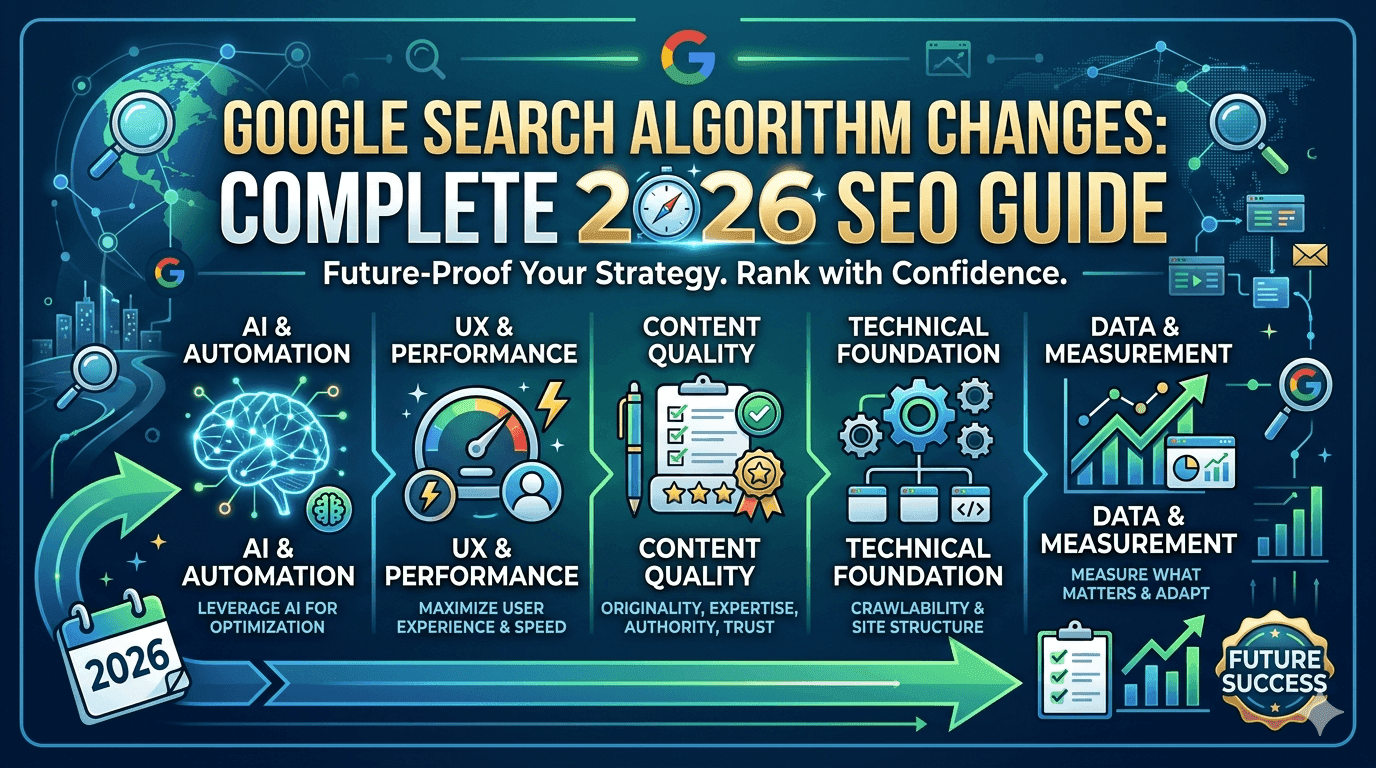
Google Search Algorithm Changes: The 2026 Complete Q&A Guide

Google updates its search algorithm thousands of times each year, but major core updates can significantly impact website rankings and organic traffic. This complete 2026 Q&A guide explains how Google algorithm changes work, what factors influence rankings, how AI and user experience affect search visibility, and what website owners can do to stay compliant with Google's best practices. Discover expert insights, recovery tips, and future SEO trends to help your website maintain strong search performance.

Zaheer Shaikh
Zaheer Shaikh
SEO Manager
July 22nd, 2026
2 views
Google Search Algorithm Changes: The 2026 Complete Q&A Guide

What Are Google Algorithm Updates — and Why Do They Matter?

Q: What exactly is a Google core update, and how is it different from other updates?

A core update is a broad re-evaluation of how Google judges overall content quality, relevance, and helpfulness across the entire web. Unlike targeted updates (spam, reviews, product reviews), a core update doesn't focus on a single tactic — it recalibrates how Google values every page across all niches simultaneously.

Google also releases smaller, unannounced updates constantly — thousands per year — but core updates are announced because they're large enough to cause noticeable ranking movements. Spam updates, on the other hand, are enforcement actions: they target specific manipulative practices (link schemes, AI-generated spam, doorway pages) and can roll out in hours rather than weeks.

Key distinction: A core update drop is not a penalty. It means Google has re-evaluated content quality and found competing pages more helpful. A spam update drop, however, typically means a specific tactic was detected and filtered.

Q: How many algorithm updates does Google release in a typical year?

Google has confirmed making thousands of changes to Search in a single year. The vast majority are small and unannounced. The exception is named updates, which fall into categories like core updates, spam updates, helpful content updates, and reviews updates.

In terms of named, publicly confirmed updates, Google typically releases roughly 8 to 12 per year. Core updates specifically tend to roll out 3 to 4 times a year, each taking 12–20 days to fully deploy. Spam updates can complete in under 24 hours in exceptional cases — as demonstrated in March 2026.

2026 Timeline

All Confirmed Google Algorithm Updates of 2026

Q: What are all the confirmed Google algorithm updates that have rolled out in 2026 so far?

As of June 9, 2026, Google has confirmed four significant algorithm updates this year. Here's the full timeline:

  • Discover Core Update Feb 5–27, 2026 — The first-ever Discover-only core update. Rolled out over 21 days. Affected Google Discover feeds, not standard search rankings. US English only at launch.
  • Spam Update Mar 24–25, 2026 — The fastest confirmed spam update in Google's history, completing in under 20 hours. Applied globally across all languages.
  • March Core Update Mar 27–Apr 8, 2026 — The first broad core update of 2026. Completed in just over 12 days. Caused less dramatic ranking shifts than some previous core updates.
  • May Core Update May 21–Jun 2, 2026 — The second core update of 2026, landing during Google I/O week. Completed in approximately 12 days. Second confirmed core update of the year.
Important for analysis: The March cluster (Discover update finishing Feb 27, Spam Update Mar 24–25, Core Update Mar 27) created overlapping volatility. Before diagnosing a traffic drop, identify which specific update caused it — the fix for each is different.
4
Confirmed named updates in 2026 (so far)
~20 hrs
Record rollout time (March Spam Update)
12 days
Rollout time for both core updates
3
Major updates in a single month (March)
Feb 2026

The February 2026 Discover Core Update

Q: What made the February 2026 Discover update historic, and what did it actually target?

The February 2026 Discover Core Update was a landmark event: it was Google's first-ever update specifically labeled as Discover-only. Previous core updates had always affected both standard Search rankings and Discover simultaneously. This marked a deliberate separation — Google is now treating its personalized content feed as a distinct product with its own quality signals.

The update launched on February 5, 2026 and completed its rollout on February 27, 2026 — taking 21 days. It initially applied only to English-language users in the United States, with plans for global expansion. The algorithm changes focused on three specific improvements:

  • Showing users more relevant content from websites based in their geographic location
  • Reducing sensational content and clickbait in Discover feeds
  • Surfacing more in-depth, original, and timely content from websites with proven expertise
If your Discover traffic dropped in February, this update is the likely cause — not the March core update. Use Search Console and switch the "Search type" to Discover to isolate the data.

Q: How should publishers optimize for Google Discover in 2026?

The February update's focus areas provide a clear roadmap. To maintain or improve Discover visibility:

  • Publish locally relevant content — Discover now favors content from websites geographically aligned with the user, so regional publishers have an advantage
  • Eliminate clickbait headline patterns — Sensationalism, exaggerated claims, and curiosity-gap headlines are actively filtered
  • Prioritize original reporting and timely angles — Fresh content with first-hand expertise and unique perspectives earns more surface area in feeds
  • Strong E-E-A-T signals — Proven expertise on a topic cluster matters for Discover just as it does for Search
  • High-quality featured images — Discover is a visual feed; compelling, original images directly influence card performance
Mar 2026

The March 2026 Spam Update

Q: Why was the March 2026 Spam Update called "the fastest in history," and what did it target?

The March 2026 Spam Update holds the record for the fastest confirmed spam update ever, completing in just under 20 hours — from March 24, 2026 at 12:18 PDT to March 25. Previous spam updates typically took 7 to 26 days. Google did not explain the record speed, though it suggests increasingly sophisticated and automated spam detection infrastructure.

Google described it as a "normal spam update" — meaning no paradigm shift, no new spam categories, and no revised guidelines. The update was global, applying across all languages and regions. Per Search Engine Roundtable reporting, two key things it did not target: link spam specifically, and Site Reputation Abuse (parasite SEO).

What it did target, consistent with SpamBrain's established capabilities:

  • Unnatural and manipulative link schemes
  • Doorway pages designed to funnel users to other destinations
  • Mass-produced, low-quality AI-generated content
  • Deceptive or misleading pages that violate Google's spam policies
Silver lining: Legitimate, quality-focused sites sometimes benefit from spam updates — when spammy competitors are filtered out, more SERP real estate opens up for well-run websites.

Q: Was it a coincidence that the Spam Update came just days before the March Core Update?

Probably not. SEO analysts noted that the spam-then-core sequencing appeared deliberate. As Search Engine Journal's Roger Montti analyzed, spam filtering is logically part of a broader quality reassessment — similar to "clearing the table" before recalibrating core ranking signals. By removing manipulative content from the index first, the subsequent core update can make cleaner quality judgments without the noise of spam pages distorting the landscape.

This three-update cluster in a single month (Discover update completing Feb 27, Spam Update Mar 24–25, Core Update Mar 27) reflects Google accelerating its quality enforcement across multiple dimensions simultaneously.

Mar–Apr 2026

The March 2026 Core Update

Q: What happened during the March 2026 Core Update and who was most affected?

The March 2026 Core Update — Google's first broad core update of the year — began rolling out on March 27, 2026 and completed on April 8, 2026, taking just over 12 days. Initial data showed less dramatic ranking shifts compared to some previous core updates, suggesting a more refined and targeted quality reassessment rather than a sweeping shake-up.

Industries most affected included health, finance, and education — Google's traditional YMYL (Your Money or Your Life) sectors, where E-E-A-T signals carry the most weight. The categories that lost visibility:

  • Thin or generic content with no real depth or original perspective
  • Outdated pages that hadn't been refreshed or updated
  • Content lacking verifiable author credentials or expertise signals
  • Pages with weak or absent internal linking structures

Winners: Sites with expert authors, original insights, strong user experience signals, and well-structured technical SEO generally maintained or improved their positions.

Q: My rankings dropped right after the March 2026 Core Update. How do I diagnose whether it was the spam update or the core update?

Timing is your primary diagnostic tool:

  • If your ranking drops occurred around March 25 — the spam update is the likely cause. Look for sudden, steep drops on specific pages
  • If drops occurred around March 28–29 onward — the core update is more likely responsible. Core update impacts tend to be more gradual and affect topical clusters rather than individual pages
  • If Discover traffic dropped around late February — that was the Discover update, separate from both March events
Important: Google recommends waiting at least one full week after an update completes before pulling Search Console data and drawing conclusions. Reacting during a rollout risks making changes based on temporary fluctuations, not stable signals.

In Search Console, compare impressions, clicks, and average position for the 14 days before and after the update window. Examine page-level and query-level data to find which pages and keywords moved, then assess whether the update's focus matches the type of content that lost ground.

May–Jun 2026

The May 2026 Core Update

Q: What do we know about the May 2026 Core Update, and what made its timing unusual?

The May 2026 Core Update began rolling out globally on May 21, 2026 and was confirmed complete on June 2, 2026 — taking approximately 12 days. It is the second confirmed core update of 2026 and the fourth confirmed ranking update of the year overall.

What made the timing unusual: the update launched during Google I/O week, where Google simultaneously announced a wave of AI and Search-related features. This overlap means ranking movements during the May 21 – June 2 window could reflect either the core update or the broader Search changes announced at I/O. Isolating cause and effect is harder than with a typical update.

Analyst guidance: Use the weeks before May 21 as your baseline, and compare against performance after the rollout finished on June 2. Wait at least one full week after completion before reviewing data or making site changes in response.

Google's framing was consistent with previous updates: "a regular update designed to better surface relevant, satisfying content for searchers from all types of sites." No new ranking systems were introduced, and Google pointed site owners back to its existing helpful content guidance. The update also affected Google Discover, featured snippets, and other Search features beyond standard organic rankings.

Q: The March and May core updates arrived about six weeks apart. Is Google updating more frequently in 2026?

Many analysts had actually expected more frequent core updates in 2026 given the pace of change in Search, but the gap between March (completing April 8) and May (starting May 21) was roughly six weeks — relatively standard. The broader pattern in 2026 is less about update frequency and more about update density: multiple different update types (Discover, Spam, Core) firing within tight windows of each other.

Based on recent patterns, expect 3 to 4 core updates per year, with additional spam, product reviews, and system-specific updates filling the gaps. The overall message is clear: Google's quality enforcement is continuous, not periodic.

AI Search

AI Overviews, AI Mode & the New Search Landscape

Q: How are AI Overviews changing the SEO game in 2026, and is the CTR damage as bad as reported?

The impact is real and significant. Research by Ahrefs measured a 58% lower average CTR on the top-ranking page for keywords with AI Overviews. Pew Research documents an 8% click rate when AI Overviews are present, versus 15% without — nearly half. Separate tracking data shows a drop in average CTR from 1.76% to 0.61% for AIO-covered queries.

However, there's a nuanced counter-narrative: sites cited inside AI Overviews actually gain traffic. Research suggests cited pages gain 35% more organic clicks and 91% more paid clicks compared to non-cited competitors. The problem is losing traffic if you rank on page one but are not cited in the AIO above you.

The strategic shift: Stop optimizing for position #1 in isolation. Being cited in an AI Overview now matters as much as — and sometimes more than — ranking first in the blue links below it.

Google officially confirmed on May 15, 2026 that GEO (Generative Engine Optimization) and AEO (Answer Engine Optimization) are not separate disciplines — they are still SEO. The fundamentals of strong content, clear structure, and E-E-A-T apply equally to AI citation as to traditional ranking.

Q: What actually gets cited in Google AI Overviews? What are the new ranking signals?

AI Overviews draw from the same underlying ranking infrastructure as organic search — but with distinct citation preferences. Here's what the data shows:

  • E-E-A-T signals are mandatory: 96% of AI Overview citations come from sources with strong Experience, Expertise, Authoritativeness, and Trustworthiness signals
  • Optimal passage length is 134–167 words: AI extracts best from concise, self-contained "semantic units." 62% of featured content lands between 100–300 words per passage
  • Structured data boosts citation by 3×: Pages with proper schema markup are three times more likely to earn AI citations
  • Top ranking is no longer required: 47% of AI Overview citations come from pages ranking below position #5 — domain authority correlations have dropped sharply
  • Freshness matters critically: There's a documented "citation cliff" where stale content loses AI visibility within months. AI systems favor fresh, timestamped, recently updated content
  • Multimodal content outperforms: Pages combining text, images, video, and schema markup achieve dramatically higher selection rates in AI results
The overlap between top Google links and AI-cited sources has reportedly fallen from around 70% to below 20% — meaning page-one ranking no longer guarantees AI visibility, and AI visibility no longer requires page-one ranking.

Q: What is Google AI Mode and how is it different from AI Overviews?

AI Overviews are the AI-generated summaries that appear at the top of standard Google Search results pages. They surface automatically for queries where Google determines a synthesized answer would serve the user.

AI Mode is a separate, opt-in conversational search experience — a dedicated interface where users interact with Google's AI in a back-and-forth dialogue, similar to how one might interact with ChatGPT or Perplexity, but powered by Google's index and Gemini models. Google announced further expansion and new features for AI Mode during Google I/O 2026 in May.

For SEO strategy in 2026, both matter. Google Search Console currently reports AI feature clicks inside the general Web performance report, making precise measurement of AI Mode and AIO impact challenging — treat it as one signal rather than a complete picture. For brands serious about AI visibility, third-party tools (Ahrefs' AI Visibility toolkit, Semrush's AI tracking, tools like Profound and Bear AI) now track citations across Google AIO, ChatGPT, Perplexity, and Gemini.

Quality Signals

E-E-A-T, Helpful Content & Quality Signals in 2026

Q: What does E-E-A-T mean in 2026 and has it changed since it was introduced?

E-E-A-T stands for Experience, Expertise, Authoritativeness, and Trustworthiness. It's Google's framework for evaluating whether content comes from a credible, knowledgeable source. The first "E" for Experience was added in December 2022 to specifically reward first-hand, lived experience with a topic — not just academic or professional expertise.

In 2026, E-E-A-T has evolved from a quality checklist into what many describe as a mandatory filter for AI citation. It's no longer just a signal that helps you rank better — it's increasingly a prerequisite for appearing in AI Overviews at all. Practical implications:

  • Author bylines with verifiable credentials are now essential, not optional
  • First-hand experience markers — case studies, original data, personal testing — carry significant weight over generic summaries
  • Entity recognition matters: being mentioned on authoritative third-party sites, industry directories, and news sources strengthens your entity signals and AI citation rate
  • Content freshness is now part of trust — outdated content without update timestamps signals neglect, not expertise

Q: Is AI-generated content still acceptable in 2026, or has Google cracked down further?

Google's official position has been consistent: the origin of content (human or AI) is not the issue — the quality and helpfulness is. However, the practical reality in 2026 is more nuanced.

The March 2026 Spam Update's targeting of mass-produced, low-quality AI-generated content signals that volume-based AI content strategies are increasingly flagged by SpamBrain. Meanwhile, the emphasis on E-E-A-T signals that AI content without genuine first-hand experience, original data, or verifiable expertise struggles to compete in both organic rankings and AI citations.

The distinction Google is drawing: AI-assisted content created by real subject matter experts who contribute genuine insight = acceptable and potentially strong. AI-generated content designed to flood the index without adding original value = spam target.

The safe approach: Use AI for drafting, research synthesis, and editing — but ensure every published piece contains original perspectives, expert contribution, verifiable claims, and first-hand experience that AI alone cannot fabricate.
Action Plan

Recovery, Diagnosis & What To Do If You're Hit

Q: My site lost rankings after a 2026 core update. What are the concrete steps I should take?

Google's guidance is clear: there are no specific actions you can take to "recover" in the traditional sense. Core update drops aren't penalties — they're a re-evaluation. Recovery comes from genuinely improving content quality, which takes time for Google to reassess. Here's a structured approach:

Step 1 — Wait and diagnose properly

  • Wait at least one full week after the update completes before pulling data
  • In GSC, compare 14-day windows before and after the update
  • Identify the specific pages and query clusters that lost visibility
  • Look for a common thread: same content type, same topic cluster, same author pattern, or no author

Step 2 — Content quality audit

  • Does the content genuinely serve the user's need, or does it primarily target a ranking?
  • Is there first-hand experience, original data, or expert insight — or is it a synthesis of what's already online?
  • Are author credentials visible, verifiable, and appropriate for the topic?
  • Is the content current, with visible update dates? Evergreen content should be refreshed every 6–12 months

Step 3 — Technical health check

  • Core Web Vitals — sites with strong performance metrics have better user engagement signals
  • Crawlability — routine crawl inspections prevent indexing issues that compound ranking losses during updates
  • Internal linking — tighten your internal link structure to pass authority efficiently to key pages
  • Schema markup — implement structured data where relevant; it improves AI citation odds significantly

Q: Is there a quick checklist for algorithm-resistant SEO in 2026?

  • ✓Publish content that demonstrates genuine first-hand experience or verifiable expertise
  • ✓Include visible, credentialed author bylines with supporting authority signals
  • ✓Structure content with self-contained answer blocks (100–300 words) optimized for AI extraction
  • ✓Add FAQ sections — Q&A format is one of the strongest signals for both featured snippets and AI Overviews
  • ✓Implement relevant schema markup (Article, FAQ, HowTo, Product, LocalBusiness as applicable)
  • ✓Refresh evergreen content every 6–12 months and display visible last-updated dates
  • ✓Monitor Core Web Vitals and maintain strong page experience scores
  • ✓Build entity recognition through mentions in niche directories, industry publications, and authoritative sources
  • ✓Diversify traffic: build presence on Discover, social, email — don't rely solely on organic search
  • ✓Check GSC's Search Appearance filters to segment AI Mode and AI Overviews performance separately from traditional organic
Looking Ahead

What's Next? The Future of Google Search & SEO

Q: With AI Overviews dominating more searches, is traditional SEO dead in 2026?

No — but it has fundamentally evolved. The fundamentals that have driven rankings through every major update from Panda onward — high-quality content, trustworthy link profiles, strong E-E-A-T signals, and solid technical foundations — remain the foundation. The difference is that in 2026, these fundamentals now determine two separate outcomes: traditional ranking in the blue links, and citation visibility inside AI-generated answers.

The search landscape is also moving toward what analysts call "Agentic Search" — where AI doesn't just answer questions but actively takes actions on behalf of the user: booking appointments, purchasing products, executing tasks. This further raises the stakes for being the trusted, cited source rather than simply the ranked URL.

Google Search is not going back to what it was. The brands that treat each core update as a one-time event to recover from will find themselves in the same position after the next one. The ones that use it as a signal to build genuinely better content, stronger technical health, tighter internal linking, and real E-E-A-T signals are the ones that compound their visibility over time.

Q: How many more core updates should we expect before the end of 2026?

With two core updates already completed (March and May), and based on the established pattern of 3 to 4 core updates per year, expect at least one — and likely two — more core updates before December 2026. Historically, the second half of the year tends to see updates in the August–October and November–December windows, though Google does not announce schedules in advance.

Additionally, watch for further spam updates, product reviews updates, and potentially more platform-specific updates like the February Discover-only update — a sign that Google is increasingly willing to target specific surfaces of its Search ecosystem separately rather than always applying broad, universal changes.

The best way to stay ahead: monitor the Google Search Status Dashboard, follow Search Engine Land and Search Engine Journal for confirmed announcements, and build quality into your site as permanent infrastructure rather than a reactive patch after each update lands. 

Our Clients

Trusted by 2500+ businesses for innovative website design & development solutions.

Logo
Logo
Logo
Logo
Logo
Logo
Logo
Logo

Our Services

  • Brand, Content & Influencer Strategy→
  • UI UX, Web & Custom Tech Solutions→
  • Full-Funnel Marketing→
  • Digital Strategy & Consulting→
  • E-Commerce & Business Evolution→
  • AI, Automation Tech→

Latest Posts

Standard SSL vs Premium SSL vs Wildcard SSL vs EV SSL – Which SSL Certificate is Best for Your Website?

In today's digital world, website security is no longer optional. Whether you own a personal blog, an eCommerce store, a SaaS platform, or a corporate website, securing your website with an SSL certificate is essential. An SSL certificate encrypts the communication between your website and visitors, protects sensitive information, builds customer trust, and improves your search engine rankings. However, many website owners struggle to choose between Standard SSL, Premium SSL, Wildcard SSL, and EV SSL. In this guide, we'll explain each SSL certificate type in detail, compare their features, advantages, disadvantages, pricing, and help you determine which one is best for your business.

Zaheer ShaikhJul 22, 20260

How to Make AEO/GEO Profitable in 2026

Search is evolving faster than ever. Traditional Search Engine Optimization (SEO) is no longer the only way businesses attract organic traffic. With the rise of AI-powered search experiences such as ChatGPT, Google's AI Overviews, Gemini, Perplexity, and other generative search platforms, new optimization strategies have emerged: Answer Engine Optimization (AEO) and Generative Engine Optimization (GEO). While many businesses are investing time and resources into AEO and GEO, one critical question remains:

Zaheer ShaikhJul 22, 20262

How to Grow Your Social Media Followers: The Complete 2026 Guide

If you've been posting consistently but your follower count barely moves, the problem usually isn't effort — it's strategy. Growing social media followers in 2026 depends less on posting more and more on posting in a way the algorithm, and your audience, actually rewards.

Zaheer ShaikhJul 07, 20263

Get In Touch

logologo

Connect on Social Media

Instagram - NexGeno Technology
Overview
  • About Us
  • DevMethodology
  • Career
  • Contact
Insights
  • About Us
  • Our Clients
  • FAQ
  • Blog
Our Work
  • Testimonial
  • Casestudy
  • Portfolio
Services
  • Website Maintenance
  • Top SEO Company in Mumbai
  • Social Networking
  • AI/ML Development
  • Mobile App Development
  • Cloud Solutions Services
  • E-Commerce Website
  • Product Prototyping
  • Front-end Development
  • Digital Transformation
  • Custom Website Designing
  • Search Engine Optimization
  • Application Development
  • Website Development
  • Website Designing
Solutions
  • Multi Restaurant Management
  • Online Food Ordering System
  • Hotel Booking System
  • Chat Application
  • Lawyer Booking
  • Job Portal
  • Hospital
  • HRMS Payroll System
  • Car Rental System
  • POS
  • Billing Application
  • CRM Application
  • Recruitment Billing Application
  • Tailor Billing Application
  • School Management
Hire Developer
  • Hire Vue Js Developer
  • Hire Next Js Developer
  • Hire WordPress Developer
  • Hire OpenCart Developer
  • Hire Magento Developer
  • Hire Shopify Developer
  • Hire React JS Developers
  • Hire Angular Developers
  • Hire PWA Developers
  • Hire React Native Developers
  • Hire Lonic Developers
  • Hire Flutter Developers
  • Hire Android App Developers
  • Hire iOS App Developers
  • Hire Express JS Developers
  • Hire CodeIgniter Developers
  • Hire Laravel Developers
  • Hire PHP Developers
Industries
  • Hospitals
  • Service Provider
  • Tours & Travel
  • Pharmaceutical
  • Health Care
  • Real Estate
  • Recruitment
  • Manufacturing
  • Logistics & Distribution
  • Education / E-Learning
©2022–2026 NexGeno Technology Private Limited.

Privacy Policy Terms & Condition
Talk to our ExpertsBook An AppointmentChat on Whatsapp
logologo
  • Services

    Services

      • Brand, Content & Influencer Strategy
      • UI UX, Web & Custom Tech Solutions
      • Full-Funnel Marketing
      • Digital Strategy & Consulting
      • E-Commerce & Business Evolution
      • AI, Automation Tech
      • Website Maintenance

    Industries

    • Education / E-Learning
    • Tours & Travel
    • Service Provider
    • Hospitals
    • Pharmaceutical
    • Health Care
    • Real Estate
    • Recruitment
    • Manufacturing
    • Logistics & Distribution

    Solutions

    • CRM Application
    • HRMS Payroll System
    • Billing Application
    • POS
    • Recruitment Billing Application
    • School Management
    • Tailor Billing Application
    • Multi Restaurant Management
    • Online Food Ordering System
    • Hotel Booking System
    • Chat Application
    • Lawyer Booking
    • Job Portal
    • Hospital
    • Car Rental System

    Get a Custom Solution Now

    Connect Now
  • Our Works

    Testimonial

    • It has been great working with Nexgeno over the years on our website and online marketing

      Anil Garg

    • View More

    CaseStudy

    • Nexgeno CaseStudy

    Portfolio

    • Nexgeno CaseStudy
    • Talk to Our Experts Now

      Enquire now
  • Company

    Overview

    • About Us
    • Development Methodology
    • Career
    • Contact Us

    Insights

    • Our Clients
    • FAQs
    • Blog
    • Transform Your Business Now

      Talk to Us
    • celebrating
View Portfolio
MENU
  • Services
      • Brand, Content & Influencer Strategy
      • UI UX, Web & Custom Tech Solutions
      • Full-Funnel Marketing
      • Digital Strategy & Consulting
      • E-Commerce & Business Evolution
      • AI, Automation Tech
      • Website Maintenance
  • Industries
    • Education / E-Learning
    • Tours & Travel
    • Service Provider
    • Hospitals
    • Pharmaceutical
    • Health Care
    • Real Estate
    • Recruitment
    • Manufacturing
    • Logistics & Distribution
  • Solutions
    • CRM Application
    • HRMS Payroll System
    • Billing Application
    • POS
    • Recruitment Billing Application
    • School Management
    • Tailor Billing Application
    • Multi Restaurant Management
    • Online Food Ordering System
    • Hotel Booking System
    • Chat Application
    • Lawyer Booking
    • Job Portal
    • Hospital
    • Car Rental System
  • Our Works
  • Company