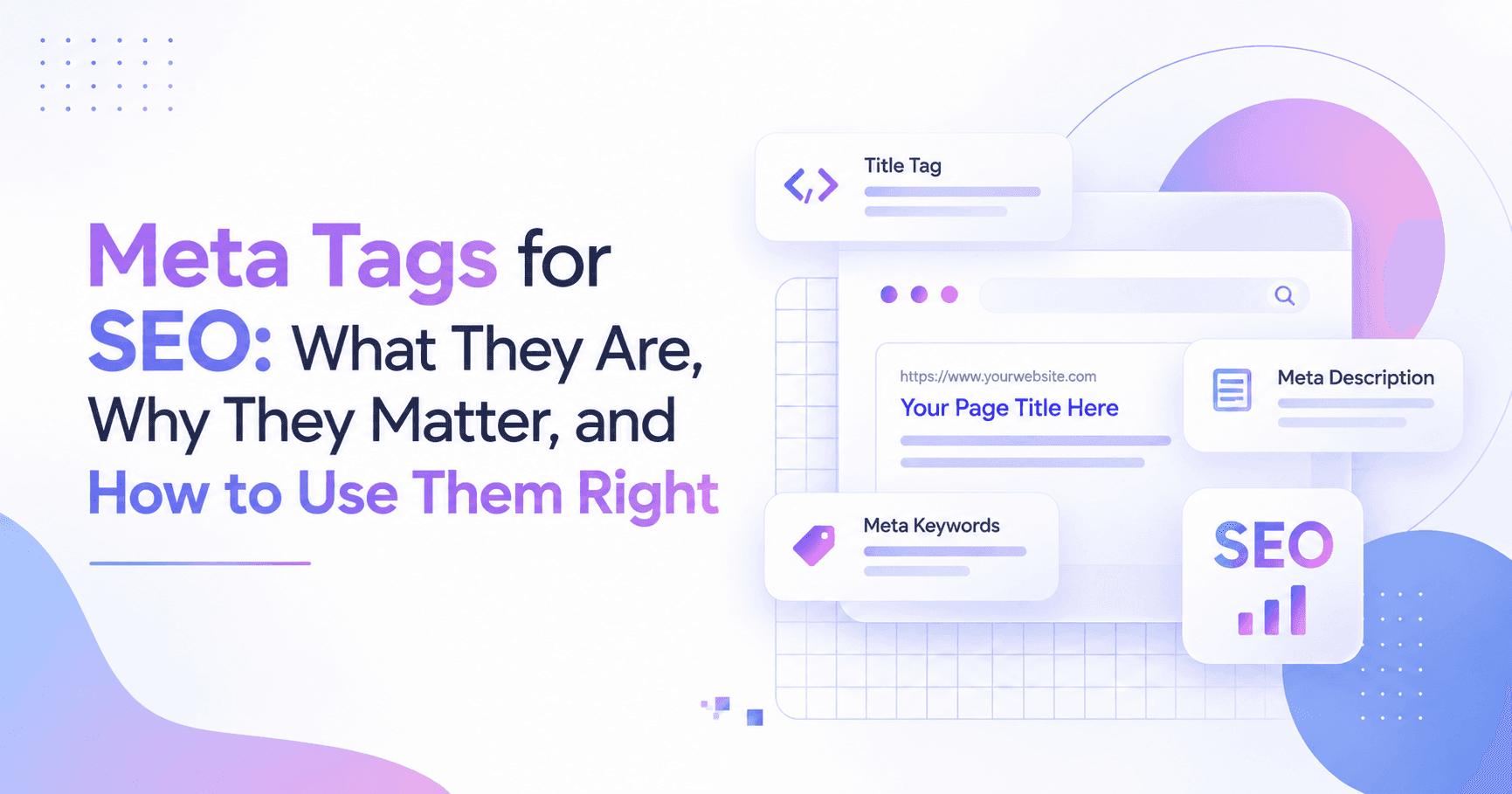
Quick Answer: What Are Meta Tags in SEO?
Meta tags are HTML elements that provide information about a webpage to search engines, browsers and other platforms. They are generally placed inside the <head> section of a webpage and are not displayed as normal visible content.
Important examples include the meta description, robots meta tag, viewport meta tag and character encoding declaration. Related elements such as the title element and canonical link are also important in SEO, although they are not technically all "meta tags."
The purpose of each element is different. Some help describe a page, some provide indexing instructions, and others control how information is presented outside the webpage.
What Are Meta Tags?
When a browser loads a webpage, the HTML contains information that describes the document. Some of that information is visible to visitors, while other information is contained in the page's metadata.
Meta tags are part of this metadata.
For example, a website can use a meta description to provide a summary of an article:
Meta description:
Learn how meta tags work, which SEO tags matter, common mistakes, and practical ways to optimise your website.
A visitor normally does not see this text as part of the article itself. Search engines can use it when generating a search-result snippet, although Google may instead select relevant text from the visible page content.
This distinction is important because metadata supports a webpage; it does not replace useful webpage content.
Why Are Meta Tags Important for SEO?
Meta tags and related metadata can affect several areas of website optimisation.
1. Search Result Presentation
Your page title and description can influence how your webpage is represented in Google Search.
Google generates title links automatically and can use several sources, including the page's <title>, visible headings, prominent text and other information.
A clear and accurate title therefore helps communicate the subject of your page.
2. Indexing and Crawling
Robots directives can provide search engines with instructions about whether a page should be indexed or how certain content should be handled.
An incorrectly implemented noindex directive, for example, can prevent an otherwise useful page from appearing in Google Search.
3. Duplicate URL Management
Websites can sometimes have multiple URLs representing the same or very similar content. Canonicalisation helps Google understand which URL is the preferred representative of that content. Google treats canonical signals as hints rather than absolute rules.
4. Mobile Rendering
Viewport metadata helps browsers display webpages appropriately across different screen sizes.
5. Social Sharing
Open Graph and X-related metadata can control information shown when a webpage is shared on supported platforms.
So, while not every metadata element directly affects rankings, metadata can play an important role in indexing, search presentation, technical SEO and user experience.
Meta Tags vs SEO Elements: What Is the Difference?
The term "meta tags" is often used broadly in SEO, but technically, several important elements are not meta tags.
For example:
- The
<title> element is a title element.
rel="canonical" is a link element.<meta name="description"> is a meta element.<meta name="robots"> is a meta element.- Open Graph properties use meta elements.
- The viewport declaration uses a meta element.
For SEO purposes, it is useful to understand all of them because they work together as part of the webpage's technical foundation.
1. Title Tag: The Most Visible SEO Metadata
The title element defines the title of an HTML document.
Google can use it when generating the title link shown in Search, along with other sources on the page.
For example:
Meta Tags for SEO: What They Are and How to Use Them
is much more descriptive than:
SEO Tips
How to write a strong SEO title
A good title should:
- Clearly describe the page.
- Match the actual content.
- Be unique where appropriate.
- Include the main topic naturally.
- Avoid unnecessary keyword repetition.
- Help users understand what they will find.
Should you keep the title between 50 and 60 characters?
Do not treat 50–60 characters as a strict Google rule.
Google does not provide a universal character limit for title elements. Search-result titles can be truncated depending on the available display space.
Instead of counting characters obsessively, focus on writing a title that is specific, descriptive and concise.
Google can also modify the displayed title when its systems determine that another source better represents the page.
2. Meta Description: Your Search Result Summary
A meta description provides a short summary of a webpage.
For example:
Meta description:
Learn how meta tags work, which SEO tags matter, common mistakes, and practical ways to optimise titles, descriptions, robots, canonical and social metadata.
A good meta description should help the searcher understand what the page offers.
Best practices for meta descriptions
- Write a relevant summary.
- Make it unique for important pages.
- Explain what users can expect.
- Include the main topic naturally.
- Avoid keyword stuffing.
- Avoid misleading claims.
- Match the description with the actual page content.
Is the meta description a ranking factor?
The meta description should not be treated as a direct ranking shortcut.
Google may use the meta description to generate a search-result snippet, but it can also use content from the webpage itself when that better matches the search query.
Is there an ideal meta description length?
There is no fixed Google character limit that guarantees a description will display completely.
Write a useful description first. Display length can vary depending on the search result and device.
3. Meta Robots Tag: Controlling Search Engine Directives
The robots meta tag provides instructions that can affect how search engines process a page.
Common directives include:
indexnoindexfollownofollownosnippetmax-snippet
One of the most important examples is noindex.
If a page contains a noindex directive and Google processes that directive, the page can be excluded from Google Search results.
Why is this important?
Imagine a business publishes a new service page.
The content is excellent.
The page is internally linked.
The website has backlinks.
But the CMS accidentally adds a noindex directive.
The page may not become eligible to appear in Google Search.
This is why checking robots directives should be part of a technical SEO audit.
When reviewing important pages, check:
- Is the page supposed to be indexed?
- Is
noindex present?
- Are indexing directives being generated correctly?
- Has a CMS or SEO plugin added an unexpected directive?
For websites that need a broader technical review, a structured SEO audit can help identify indexing, crawlability, metadata and other technical issues. Nexgeno SEO Services
4. Canonical Tag: Helping Google Understand Duplicate URLs
The canonical element is commonly called a canonical tag, although technically it is a rel="canonical" link element rather than a meta tag.
It is used to indicate the preferred URL for a piece of content when multiple URLs are duplicates or substantially similar.
For example, a website might have:
example.com/product
and:
example.com/product?colour=blue
If the URLs contain substantially similar content, canonicalisation can help communicate which URL should represent that content.
Google explains that canonicalisation is part of its process for selecting a representative URL among duplicate or very similar pages. However, a canonical declaration is a hint, not a guarantee that Google will select that URL.
Canonical SEO checklist
Check that:
- The canonical URL is correct.
- It uses the preferred HTTPS version.
- It points to a relevant page.
- It is accessible.
- Important pages do not accidentally canonicalise to unrelated URLs.
- Canonicals are reviewed after website migrations or URL changes.
Google recommends checking canonicalisation problems through tools such as URL Inspection when the selected canonical differs from your preference.
5. Viewport Meta Tag and Mobile SEO
The viewport meta tag helps browsers determine how a webpage should be displayed on different screen sizes.
A responsive website needs to provide a usable experience across:
- Smartphones
- Tablets
- Laptops
- Desktop computers
Viewport configuration is therefore an important part of modern website implementation.
However, it should not be described as a standalone Google ranking factor.
It is better understood as part of the technical foundation that supports responsive design and mobile usability.
If you're building or redesigning a website, metadata should be considered alongside page speed, responsive design, technical SEO and site architecture. Nexgeno's [website development services] include SEO-friendly development and responsive website implementation. Website Development Services
6. Charset Meta Tag
The charset declaration tells the browser which character encoding the webpage uses.
Modern websites commonly use UTF-8.
Correct character encoding helps browsers correctly display:
- Text
- Symbols
- Special characters
- Multilingual content
This is primarily a technical rendering consideration rather than a direct Google ranking factor.
For websites serving audiences in multiple languages, correct encoding becomes particularly important for providing consistent content presentation.
7. Open Graph Meta Tags
Open Graph metadata is primarily used to control how webpages are represented when shared on supported social platforms.
Common properties include:
og:titleog:descriptionog:imageog:urlog:type
For example, when someone shares a Nexgeno blog article, Open Graph metadata can help define the title, description and image shown in the preview.
Although Open Graph is primarily associated with social sharing, Google has documented og:title as one of the sources its systems may use when generating title links.
This is another reason to keep your page's important titles and descriptions consistent.
8. X/Twitter Card Metadata
X/Twitter Card metadata performs a similar function for content shared on X.
Depending on the implementation, it can provide information such as:
- Page title
- Description
- Preview image
- Card type
Its primary purpose is social sharing presentation rather than directly improving Google rankings.
For a business website, keeping social metadata aligned with the actual webpage helps create a more consistent brand experience when content is shared.
Meta Tags at a Glance
| Element |
Main Purpose |
SEO Relevance |
| Title element |
Describes the webpage |
Helps influence Google's generated title link |
| Meta description |
Summarises the page |
May influence the search-result snippet |
| Robots meta tag |
Provides indexing/crawling directives |
Can affect search eligibility |
| Canonical link |
Indicates preferred URL |
Helps Google understand duplicate URLs |
| Viewport |
Controls browser rendering |
Supports responsive mobile experience |
| Charset |
Defines character encoding |
Supports correct content rendering |
| Open Graph |
Controls social previews |
Mainly social sharing |
| X/Twitter metadata |
Controls X previews |
Mainly social sharing |
The important takeaway is that these elements do not all have the same SEO function.
How to Write SEO-Friendly Meta Titles
A useful meta title should communicate the subject immediately.
Weak example
SEO
Better example
Meta Tags for SEO: Types, Best Practices and Examples
The second version gives the searcher more information.
A practical structure is:
Main Topic + Specific Context
Examples:
Technical SEO Audit: Complete Website Checklist
Local SEO for Small Businesses: Practical Guide
Meta Tags for SEO: Types and Best Practices
Website Speed Optimisation: Core Web Vitals Guide
Don't add keywords simply because you can.
If a keyword makes the title awkward, prioritise clarity.
How to Write Better Meta Descriptions
Think about the meta description as a concise explanation of what the page contains.
Ask:
What will the reader learn by visiting this page?
For this article:
Learn how meta tags work, which SEO tags matter, common mistakes, and practical ways to optimise titles, descriptions, robots, canonical and social metadata.
The description communicates:
- The topic
- The scope
- The value
It doesn't need to become a list of keywords.
Remember that Google may generate the displayed snippet from page content instead of using your exact meta description.
How Meta Tags Support AEO
Answer Engine Optimisation is less about adding a special "AEO tag" and more about making information easy to understand and retrieve.
For an AEO-friendly article, important questions should receive direct answers.
For example:
What Is a Meta Description?
A meta description is HTML metadata that provides a summary of a webpage. Google may use it when generating a search-result snippet, although Google can also generate the snippet from visible page content.
The direct answer comes first.
The supporting explanation comes afterward.
This creates a clear:
Question → Answer → Explanation → Example
structure.
AEO-friendly content practices
- Answer questions directly.
- Use descriptive headings.
- Put important definitions near the beginning.
- Use short paragraphs where appropriate.
- Use lists for processes.
- Use tables for genuine comparisons.
- Explain technical terminology.
- Avoid unnecessary repetition.
- Support factual claims with reliable sources.
How Meta Tags Fit Into GEO and AI Search
There is no secret "GEO meta tag" that guarantees visibility in AI search.
Google's current documentation explains that its AI search experiences use the same foundational SEO practices as regular Search. Pages need to be accessible and eligible for Search, while their content should provide useful information for users.
That means the goal should not be to write content specifically for an AI system while ignoring people.
Instead, make the content:
Clear
State exactly what something means.
Contextual
Explain how related concepts connect.
For example:
Meta description → search snippet → search query → search-result presentation
Specific
Use practical examples instead of vague explanations.
Original
Add genuine experience, analysis or examples where available.
Well-structured
Use logical headings and answer important questions directly.
This approach can make content easier for both people and search systems to understand without relying on artificial GEO tactics.
Meta Tags and E-E-A-T
Metadata alone cannot establish strong E-E-A-T.
The broader page needs to demonstrate useful experience, expertise and trustworthiness.
For a Nexgeno article, this can include:
- A clear author name
- Relevant author information
- Original examples
- Accurate technical explanations
- References to authoritative documentation
- Genuine practical experience
- Updated information when the content is actually reviewed
This is particularly important for technical SEO content because readers need to distinguish between established Google guidance and generic SEO opinions.
For example, rather than saying:
"Google always ranks pages with perfect meta tags higher."
we should say:
"Meta tags help communicate information about a webpage, but they do not guarantee higher rankings. Search visibility depends on many factors and systems."
That distinction makes the article more trustworthy.
Common Meta Tag Mistakes
1. Duplicate Titles
Using the same title across many important pages makes it harder to communicate what each page is about.
2. Keyword Stuffing
Don't turn the title or description into a collection of repeated keywords.
Write for the person who will see the search result.
3. Misleading Meta Descriptions
Don't promise information that the webpage does not actually provide.
4. Accidental Noindex
Always check important pages for unexpected noindex directives.
This is particularly important after:
- Website redesigns
- CMS changes
- Plugin installations
- Website migrations
- Staging-to-live deployments
5. Incorrect Canonicals
A canonical pointing to the wrong URL can create confusing signals.
Review canonical URLs after major technical changes. Google also recommends investigating unexpected canonical selections through Search Console and URL Inspection.
6. Treating Character Counts as Hard Rules
Character recommendations can be useful writing guidelines, but they are not universal Google limits.
Google may truncate title links and snippets according to the available display space.
7. Using Meta Keywords
The old meta keywords approach should not be part of a modern Google SEO strategy.
Instead, focus on:
- Search intent
- Helpful content
- Relevant topics
- Technical accessibility
- Internal linking
- Page experience
- Clear titles
- Useful descriptions
How to Audit Meta Tags on a Website
A proper metadata audit should look beyond whether a title or description exists.
Step 1: Crawl the website
Identify important URLs and collect their metadata.
Step 2: Check title elements
Look for:
- Missing titles
- Duplicate titles
- Extremely generic titles
- Titles that don't match the page
- Unnecessary keyword repetition
Step 3: Check meta descriptions
Look for:
- Missing descriptions
- Duplicate descriptions
- Irrelevant descriptions
- Descriptions that don't represent the page
Step 4: Check robots directives
Identify pages with:
- Unexpected
noindex
- Incorrect directives
- Indexing conflicts
Step 5: Check canonical URLs
Verify that canonical URLs:
- Exist
- Are accessible
- Point to relevant pages
- Match the intended URL structure
Step 6: Check social metadata
Review Open Graph and X/Twitter metadata for important pages.
Step 7: Compare with Search Console
If Google displays something different from your expected title, snippet or canonical, investigate using Google Search Console and the relevant Search documentation rather than assuming the HTML value is always what Google will display.
Meta Tag SEO Checklist
Before publishing an important webpage, check the following.
Title
- Unique where appropriate
- Descriptive
- Relevant to the page
- Naturally written
- Consistent with visible content
Meta Description
- Accurate
- Useful
- Relevant
- Written for users
- Not stuffed with keywords
Robots
- Correct indexing directive
- No accidental
noindex
- No conflicting configuration
Canonical
- Correct preferred URL
- Accessible URL
- Relevant destination
- HTTPS where appropriate
Mobile
- Correct viewport configuration
- Responsive layout
- Usable mobile experience
Social Metadata
- Correct Open Graph title
- Correct Open Graph description
- Appropriate preview image
- Correct shared URL
Do Meta Tags Need to Be Updated Regularly?
There is no universal schedule for changing metadata.
Review metadata when the underlying page changes.
For example, update the title or description when:
- The page topic changes.
- Search intent changes.
- A service changes.
- A product changes.
- The existing title no longer accurately represents the page.
- A website migration changes URL structures.
Don't change metadata simply because a certain number of months have passed.
Instead, use Google Search Console data, actual search behaviour and the current content of the page to determine whether an update makes sense.
Frequently Asked Questions
What are meta tags in SEO?
Meta tags are HTML metadata elements that provide information or instructions about a webpage. They can help with search-result presentation, indexing directives, browser rendering and social sharing, depending on the specific element.
Are meta tags still important for SEO?
Yes, but different metadata elements serve different purposes. Titles can influence Google's generated title links, robots directives can affect indexing, and meta descriptions can influence search snippets. Metadata should be treated as one part of a broader SEO strategy.
Does the meta description affect Google rankings?
A meta description should not be treated as a direct ranking shortcut. Its main purpose is to provide a description that Google may use in the search-result snippet. Google can also generate snippets from visible content on the page.
How long should an SEO title be?
There is no universal Google character limit for title elements. Focus on creating a concise and descriptive title that accurately represents the page. Google may truncate or modify the title shown in Search depending on the situation.
How long should a meta description be?
There is no fixed Google character limit for meta descriptions. Write a useful, accurate summary rather than targeting an arbitrary number of characters. Google may display a different snippet depending on the search query.
What is a robots meta tag?
A robots meta tag provides search engine directives about how a webpage should be handled. Depending on the directive, it can influence whether content is indexed or how snippets and other search-result features are handled.
What is a canonical tag?
A canonical tag is a rel="canonical" link element that indicates the preferred URL for duplicate or substantially similar content. Google considers canonicalisation as one of several signals when selecting a representative URL.
Are meta keywords still useful?
No. Meta keywords should not be part of a modern Google SEO strategy. Focus instead on useful content, search intent, technical accessibility and relevant topical coverage.
Do meta tags matter for AI search?
Metadata remains part of a website's technical foundation, but there is no special meta tag that guarantees inclusion in AI search features. Google's current guidance says its AI search experiences rely on the same foundational SEO practices used for Search.
Can changing meta tags improve organic traffic?
It can improve how a page is represented in search, but results are not guaranteed. Better titles and descriptions can make a search result more relevant and useful to users, while technical directives such as noindex and canonicalisation can affect whether and which URLs are eligible or represented in Search.
Key Takeaways
- Meta tags provide information or instructions about webpages.
- Not every important SEO HTML element is technically a meta tag.
- Title elements help communicate the topic of a page and can influence Google's generated title link.
- Meta descriptions can influence search snippets, but Google may generate snippets from page content.
- Robots directives can affect indexing and search-result behaviour.
- Canonicalisation helps Google understand relationships between duplicate or similar URLs.
- Viewport metadata supports responsive rendering.
- Open Graph and X/Twitter metadata mainly control social sharing previews.
- 50–60 characters and 120–158 characters should not be presented as hard Google limits.
- There is no "magic" GEO meta tag for AI search.
- Metadata should support, not replace, useful and original webpage content.
Conclusion
Meta tags are a small but important part of a website's technical foundation.
Their real value comes from using each element for the correct purpose.
A descriptive title helps communicate the topic of a webpage. A useful meta description can help Google understand how you want the page summarised. Robots directives can provide important indexing instructions, while canonicalisation helps search engines understand relationships between similar URLs.
But effective SEO goes beyond metadata.
Your website also needs useful content, logical internal linking, crawlable architecture, good page experience, relevant search intent and a technically sound implementation.
For businesses investing in SEO, the goal should not be to optimise individual meta tags in isolation. The goal is to create a website where content, technical SEO, metadata and user experience work together.
Need Help With Your Website SEO?
Nexgeno Technology provides SEO services covering on-page optimisation, technical SEO, content optimisation, website audits and search performance tracking. Nexgeno SEO Services
If your website has missing metadata, indexing issues, duplicate URLs or technical SEO problems, a structured website audit can help identify the issues that need attention.
You can also explore Nexgeno's broader digital marketing services and website development services.
Need an SEO audit for your website? Contact Nexgeno Technology to discuss your requirements. Contact Nexgeno Technology
Author
Zaheer Shaikh
SEO Manager at Nexgeno Technology, with 3+ years of experience running SEO campaigns across audits, content strategy, and performance reporting.