How to Make AEO/GEO Profitable in 2026
Search is evolving faster than ever. Traditional Search Engine Optimization (SEO) is no longer the only way businesses attract organic traffic. With the rise of AI-powered search experiences such as ChatGPT, Google's AI Overviews, Gemini, Perplexity, and other generative search platforms, new optimization strategies have emerged: Answer Engine Optimization (AEO) and Generative Engine Optimization (GEO). While many businesses are investing time and resources into AEO and GEO, one critical question remains:

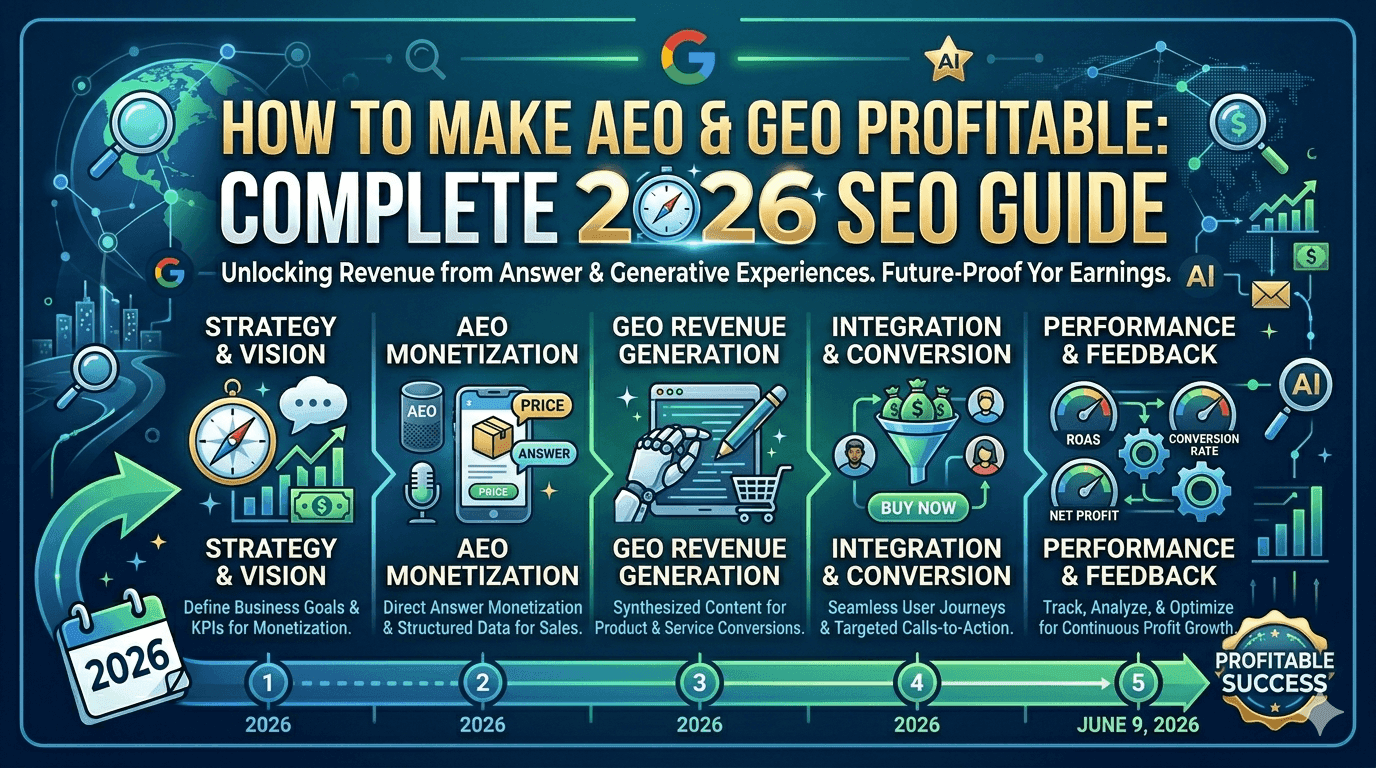
Everyone in the SEO industry is talking about AEO and GEO right now. But most of that conversation stops at "what it is" and never gets to the part that actually matters for your business: how do you make money from it?
94% of CMOs plan to increase AEO spending this year. That budget surge has already attracted every SEO agency, growth consultancy, and freelancer to slap "AEO" and "GEO" on their services page overnight — most of them simply repackaging the same SEO playbook with a new label.
The agencies and brands that will actually profit from this shift are the ones who understand what these disciplines genuinely require, how to deliver measurable outcomes, and how to turn AI visibility into real business results.
This blog breaks all of that down.
First, Let's Get Clear on What AEO and GEO Actually Are
Before you can monetize anything, you need to understand what you're selling and delivering.
AEO optimizes for direct answer placement in featured snippets, voice assistants, and AI answer boxes. GEO optimizes for citations within generative AI responses from ChatGPT, Perplexity, and similar platforms.
In practice, the two overlap heavily. GEO is the practice of optimizing content so that LLMs like ChatGPT and Gemini cite it as a trusted source in their responses. Unlike traditional search engines that provide a list of ranked links for users to parse, LLMs synthesize answers from multiple sources.
The scale of this shift is hard to ignore. ChatGPT alone processes 2.5 billion prompts daily, 65% of which qualify as search. And on Google, over 60% of searches now end without a click to a third-party website, with AI-generated answers accelerating this shift.
The bottom line: traditional SEO gets you ranked. AEO/GEO gets you cited, quoted, and recommended — which is increasingly where the actual discovery happens.
Why AEO/GEO Is a Genuine Business Opportunity Right Now
The window is open — but won't stay open forever
Companies investing in GEO strategies capture disproportionate visibility during the critical 2026–2028 transition period. This is the early-mover window. Most businesses either haven't heard of AEO/GEO yet, or they've heard the terms but haven't acted. The brands that build authority, structure, and citation signals now will be very difficult to displace once these systems mature.
The monetization logic is straightforward
Each platform has its own preference profile, which means there's a clear, deliverable body of work:
Google AI Overviews pull from top-10 results, so you optimize for traditional SEO first, then add snippable structure. Perplexity rewards freshness, authority, and multi-channel presence. Microsoft Copilot leans heavily on LinkedIn for B2B queries. Gemini analyzes multimodal content like video and images.
That's a platform-specific strategy you can audit, execute, and report on for every client.
Paid placement is coming
Just as paid ads transformed search, monetization layers are coming to generative results. Expect to see sponsored AI answers or verified brand placements. Early adopters with optimized entities will be first in line for these premium opportunities.
How to Profit as an Agency Offering AEO/GEO Services
1. Sell it as an evolution of SEO, not a replacement
The biggest mistake agencies make is positioning AEO/GEO as something entirely new that clients need to buy separately. SEO is still the core discipline for earning discoverability. AEO is how that work adapts to answer-first search experiences. The same foundation must now support answer extraction, citation, and summary inclusion — which requires changes in content structure, trust presentation, and measurement.
Frame it to clients this way: "The SEO work we're already doing is the foundation. AEO/GEO is the next layer that makes sure your brand gets cited inside AI answers, not just ranked below them."
This framing makes it a natural upsell rather than a scary new investment.
2. Build a productized service around the audit
The easiest entry point for profitable AEO/GEO work is an AI Visibility Audit. This is a defined, deliverable product that:
- Checks if the client's site is being cited in Google AI Overviews, ChatGPT, Perplexity, Gemini, and Copilot
- Identifies which pages are being ignored and why
- Assesses schema markup, structured content, E-E-A-T signals, and entity recognition
- Benchmarks the client against 2–3 competitors
This is a standalone paid engagement that almost always leads to ongoing retainer work because it reveals a clear gap that needs filling.
3. Structure your retainer around three deliverable pillars
The most profitable AEO/GEO retainers are built around three ongoing workstreams:
Pillar 1 — Content restructuring. Rewriting and reformatting existing pages to include self-contained answer blocks, FAQ sections, and Q&A-format content that AI systems can extract from. Every page should be able to answer a specific question in 100–300 words without requiring the reader to read the whole article.
Pillar 2 — Technical & schema layer. Implementing FAQ schema, HowTo schema, Article schema, and entity markup. Pages with proper schema markup are three times more likely to earn AI citations. This is high-value, low-effort work that delivers measurable lift.
Pillar 3 — Authority & entity building. Getting the client mentioned, quoted, and linked from niche publications, industry directories, and authoritative sources. By focusing on getting mentioned in niche industry directories and news sites, brands have seen their AI citation rate jump by 40% in two months. This is the off-page component of GEO and maps naturally to the link-building work agencies already do.
4. Report on the metrics that matter
The reason most AEO/GEO services fail to renew isn't poor execution — it's poor reporting. Clients don't understand what AI visibility metrics mean, so they can't see the value.
Clients need a dashboard that tells a coherent story. AEO becomes easier to renew when the reporting connects technical changes, content improvements, answer visibility, and business outcomes in the same narrative.
The metrics to report on:
- AI citation rate — how often the client is cited across Google AIO, ChatGPT, Perplexity, Gemini
- Share of Voice in AI answers — what % of AI responses in their topic cluster mention the client vs competitors
- Featured snippet ownership — how many target queries the client owns the direct answer for
- Traditional organic traffic — because the SEO foundation still matters and should be tracked alongside
- Leads/revenue from cited pages — the bridge between AI visibility and business outcomes
Tools to use for tracking: Platforms like Profound, Bear AI, and ZipTie have become industry standards for tracking how often a brand is cited across different LLMs. Ahrefs and Semrush have also caught up with AI Visibility toolkits that show exactly which pages are being used as cited sources in AI Overviews.
5. Price it properly
Agencies that undercharge for AEO/GEO work are treating it like a commodity when it's actually specialized. A realistic pricing structure:
- AI Visibility Audit — one-time engagement, priced as a standalone deliverable
- AEO/GEO Retainer — monthly fee combining content restructuring, schema implementation, entity building, and reporting
- Premium tier — includes multi-platform citation tracking via dedicated tools, competitive share of voice analysis, and strategic consulting
Don't discount it to close deals. The demand is real and the supply of agencies who can genuinely deliver it is still low.
How to Profit as a Business (Not an Agency)
If you're a brand or publisher rather than a service provider, here's how AEO/GEO becomes profitable for you directly.
Get cited in AI Overviews — then convert better
Being cited inside an AI Overview doesn't just drive awareness. Sites cited in AI Overviews find that even though fewer people click through, the ones who do have already read the brand's core value proposition in the AI-generated summary. They are more "pre-sold" by the time they hit the site. Traffic quality goes up even as raw volume might fluctuate.
Own your category's Q&A real estate
Every industry has a set of high-intent questions buyers ask before making a purchase decision. If your content is the one being cited when someone asks those questions to ChatGPT, Gemini, or Google AI Mode — you are the default recommendation in your category. That is an enormous competitive moat and a direct driver of leads and conversions.
Use AI Overviews visibility to support paid strategy
Cited pages gain 35% more organic clicks and 91% more paid clicks compared to non-cited competitors. If you're running paid search alongside your organic strategy, being the cited source in AI Overviews creates a credibility halo that lifts your paid performance as well. This is one of the strongest ROI arguments for AEO/GEO investment.
The Practical Execution Checklist
Regardless of whether you're an agency or a brand, these are the concrete actions that move the needle:
Content structure
- Rewrite key pages to include a clear, direct answer in the first 150 words
- Add FAQ sections to every important landing page and blog post
- Write in natural Q&A language — the format AI systems are built to extract from
- Build comprehensive topic clusters so you own the full conversation, not just one page
Technical layer
- Implement FAQ schema, Article schema, and relevant business schema across the site
- Add visible author bylines with credentials and supporting author pages
- Include publication and last-updated dates on every piece of content
- Ensure the site is fast, crawlable, and passes Core Web Vitals
Authority and entity signals
- Get the brand and key people mentioned in authoritative industry publications
- Build a presence in niche directories relevant to the industry
- Publish original data, case studies, and proprietary research — these are cited at a significantly higher rate than generic summaries
- Be consistent in how the brand name, products, and services are described across all platforms
Measurement
- Set up GSC filtering by Search Appearance to track AI Overview impressions separately
- Use at least one dedicated AI citation tracking tool
- Track share of voice in AI answers monthly against 2–3 competitors
- Connect citation trends to leads and revenue, not just visibility metrics
The One Mistake to Avoid
Most agencies are repackaging the same SEO playbook with a new label and hoping clients won't notice. That works for a quarter, maybe two. But when clients ask for proof of AI citation improvement and you can't show them anything beyond ranking reports, the retainer dies.
The agencies and brands that will build lasting, profitable AEO/GEO practices are the ones who do the actual structural work — genuinely restructuring content, building real authority signals, implementing schema properly, and reporting on AI-specific metrics. No one can guarantee AI placement. Anyone promising that is lying. What you can guarantee is that the structural foundations are in place to give a brand the best possible chance.
That's the work. And right now, very few people are doing it properly. That gap is your opportunity.
Final Thought
SEO is not being replaced by GEO — it is being expanded. Traditional SEO remains essential for organic search rankings, which still drive the majority of web traffic. GEO adds a new layer focused on earning citations in AI-generated responses. The brands and agencies that understand this — and build both disciplines into a unified strategy — will be the ones compounding their visibility and revenue through the rest of this decade.
The window is open. The competition is still thin. The work is clearly defined. The only question is whether you move now or wait until everyone else has caught up.
Our Clients
Trusted by 2500+ businesses for innovative website design & development solutions.







Our Services
Latest Posts
Custom CRM vs. Off-The-Shelf Software: Why Growing Indian Businesses Need Tailored Systems
Mastering custom crm software development mumbai requires adopting structured, evidence-based practices that prioritize quality, cost transparency, and procedural safety. By aligning with verified industry benchmarks, users and businesses can overcome seasonal challenges, streamline decision-making, and achieve long-term reliability without unexpected expenses. Navigating modern requirements for custom crm software development mumbai has become increasingly critical as market conditions and seasonal priorities evolve in Q4. Whether addressing personal needs, travel logistics, or business transformations, having clear technical guidance eliminates costly missteps. At Nexgeno Technology, our team of dedicated domain specialists provides high-impact solutions designed for reliability and measurable success. In this comprehensive guide for October Week 4, we analyze key industry considerations, evaluate practical alternatives, and provide an actionable roadmap for optimal results.
GEO by Engine: How ChatGPT, Claude, Gemini, and Perplexity Choose What to Show
Generative AI has changed how people search for information. Instead of typing a short keyword into Google and opening several websites, users can now ask complete questions to platforms such as ChatGPT, Claude, Gemini, and Perplexity and receive a conversational answer within seconds. That creates a new challenge for businesses. Ranking on Google is still important, but brands also need to understand how their content can become visible, referenced, mentioned, and cited inside AI-generated answers. This is where Generative Engine Optimization (GEO) becomes important. However, there is one major misconception: there is no universal GEO formula that works identically across every AI platform. ChatGPT, Claude, Gemini, and Perplexity have different products, retrieval systems, data sources, and ways of presenting information. Their exact ranking and selection mechanisms are proprietary, so nobody outside the companies operating these systems can provide a complete formula. What marketers can do is study their publicly documented capabilities, observable behaviour, search experiences, and content requirements — then build content that is useful across these different environments. In this guide, we will break down how GEO differs across ChatGPT, Claude, Gemini, and Perplexity, what businesses should focus on, and how traditional SEO fits into the AI-search era.
Meta Tags for SEO: What They Are, Why They Matter, and How to Use Them Right
Meta tags are small pieces of information added to a webpage's HTML that help search engines, browsers and other platforms understand or process the page. Some metadata can influence how a page is indexed or represented in Google Search, while other elements mainly affect how the page appears when shared on social platforms. For modern SEO, meta tags should not be treated as a ranking shortcut. A strong SEO strategy combines metadata with useful content, technical accessibility, internal linking, site structure, page experience and search intent. In this guide, we will explain the most important meta tags and related HTML elements, what each one does, how to optimise them, common mistakes to avoid, and how metadata fits into modern SEO and AI-powered search.
Get In Touch










- Website Maintenance
- SSL Certificates
- Top SEO Company in Mumbai
- Social Networking
- AI/ML Development
- Mobile App Development
- Cloud Solutions Services
- E-Commerce Website
- Product Prototyping
- Front-end Development
- Digital Transformation
- Custom Website Designing
- Search Engine Optimization
- Application Development
- Website Development
- Website Designing
- Hire Vue Js Developer
- Hire Next Js Developer
- Hire WordPress Developer
- Hire OpenCart Developer
- Hire Magento Developer
- Hire Shopify Developer
- Hire React JS Developers
- Hire Angular Developers
- Hire PWA Developers
- Hire React Native Developers
- Hire Lonic Developers
- Hire Flutter Developers
- Hire Android App Developers
- Hire iOS App Developers
- Hire Express JS Developers
- Hire CodeIgniter Developers
- Hire Laravel Developers
- Hire PHP Developers