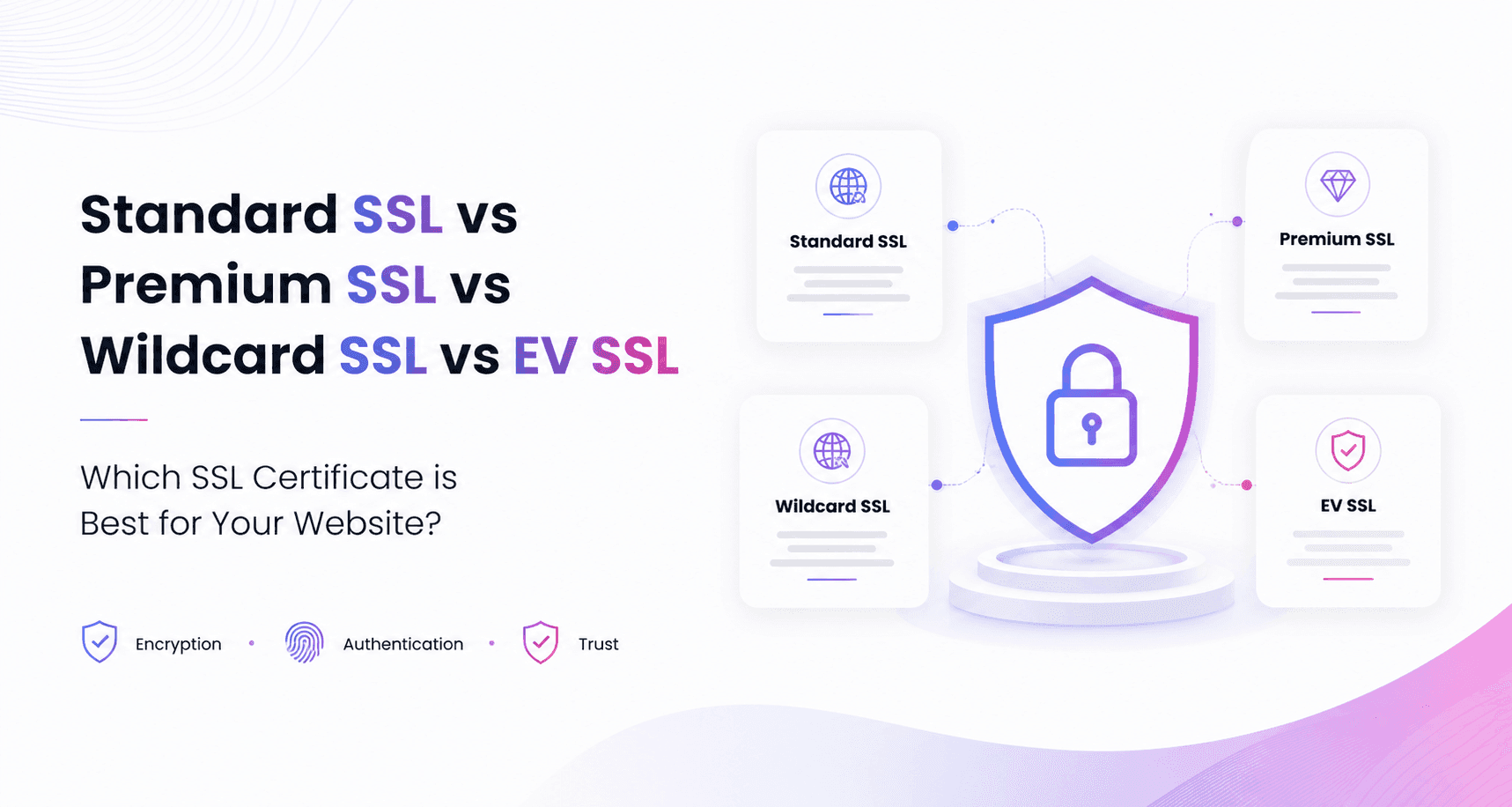
Standard SSL vs Premium SSL vs Wildcard SSL vs EV SSL – Which SSL Certificate is Best for Your Website?
In today's digital world, website security is no longer optional. Whether you own a personal blog, an eCommerce store, a SaaS platform, or a corporate website, securing your website with an SSL certificate is essential. An SSL certificate encrypts the communication between your website and visitors, protects sensitive information, builds customer trust, and improves your search engine rankings. However, many website owners struggle to choose between Standard SSL, Premium SSL, Wildcard SSL, and EV SSL. In this guide, we'll explain each SSL certificate type in detail, compare their features, advantages, disadvantages, pricing, and help you determine which one is best for your business.

What is an SSL Certificate?
SSL (Secure Sockets Layer), now technically replaced by TLS (Transport Layer Security), is a security protocol that encrypts data exchanged between a web browser and a web server.
When a website has an SSL certificate installed, visitors will see:
- HTTPS instead of HTTP
- Secure padlock icon in the browser
- Encrypted communication
- Improved trust
- Better SEO performance
Without SSL, browsers may display a "Not Secure" warning, which can discourage users from interacting with your website.
Why is SSL Important?
Installing an SSL certificate provides several benefits:
- Encrypts customer data
- Protects login credentials
- Secures payment information
- Improves Google search rankings
- Builds customer confidence
- Meets security compliance requirements
- Prevents data interception by hackers
Whether you operate a small business website or a large enterprise portal, SSL has become a basic requirement.
Types of SSL Certificates
There are four major SSL certificate categories:
- Standard SSL
- Premium SSL
- Wildcard SSL
- Extended Validation (EV) SSL
Let's understand each one in detail.
1. Standard SSL Certificate
Best For:
- Personal websites
- Blogs
- Portfolio websites
- Landing pages
- Small business websites
- WordPress websites
A Standard SSL is the most affordable SSL certificate available. It generally uses Domain Validation (DV), meaning the Certificate Authority only verifies that you own the domain.
No business documents or company verification are required.
Validation Level
- Domain Ownership Verification
- Instant issuance
- Automated verification
Encryption
Although it is inexpensive, the encryption strength is exactly the same as expensive SSL certificates.
Typical encryption includes:
- 256-bit Encryption
- TLS 1.2
- TLS 1.3
This means your website remains fully encrypted and secure.
Covers
- example.com
- www.example.com
Does Not Cover
- blog.example.com
- shop.example.com
- api.example.com
- mail.example.com
Each subdomain requires a separate certificate unless you purchase a Wildcard SSL.
Advantages
- Lowest cost
- Quick installation
- HTTPS enabled
- Excellent for SEO
- Ideal for startups
Limitations
- No business identity verification
- Lower trust for enterprise customers
Typical Pricing
- Free (Let's Encrypt)
- ₹300 – ₹2,000 per year
2. Premium SSL Certificate
Best For
- Corporate websites
- SaaS platforms
- IT companies
- CRM software
- Agencies
- Educational institutions
- Healthcare organizations
Premium SSL generally refers to an Organization Validation (OV) SSL certificate.
Unlike Standard SSL, the Certificate Authority verifies both the domain ownership and the legal existence of your business.
Validation Includes
- Domain ownership
- Company registration
- Business address
- Organization details
- Contact verification
Visitors can inspect the SSL certificate and verify the company that owns the website.
This increases trust and credibility.
Covers
- company.com
- www.company.com
Advantages
- Business identity verified
- Higher customer confidence
- Suitable for B2B businesses
- Trusted by enterprise clients
- Better corporate credibility
Limitations
- Higher cost
- Slightly longer issuance process
Typical Pricing
₹3,000 – ₹15,000 per year
3. Wildcard SSL Certificate
Best For
- SaaS companies
- Hosting providers
- Agencies
- Enterprises
- Businesses with multiple subdomains
Wildcard SSL is one of the most cost-effective SSL certificates for growing businesses.
Instead of purchasing separate SSL certificates for every subdomain, a single Wildcard SSL secures all first-level subdomains.
Example
One Wildcard SSL can secure:
- example.com
- www.example.com
- blog.example.com
- crm.example.com
- mail.example.com
- api.example.com
- shop.example.com
- client.example.com
This significantly reduces management effort and renewal costs.
Important Note
Wildcard SSL typically secures unlimited first-level subdomains.
It generally does not secure nested subdomains such as:
- api.dev.example.com
unless specifically supported.
Advantages
- Unlimited first-level subdomains
- Single SSL certificate
- Easier management
- Cost-effective
- Simplified renewals
Limitations
- More expensive than Standard SSL
- Does not usually include Extended Validation
Typical Pricing
₹8,000 – ₹45,000 per year
4. EV SSL (Extended Validation SSL)
Best For
- Banks
- Financial institutions
- Payment gateways
- Insurance companies
- Government portals
- Large enterprises
- High-value eCommerce websites
Extended Validation (EV) SSL offers the highest level of identity verification.
The Certificate Authority performs extensive checks before issuing the certificate.
Verification Includes
- Domain ownership
- Company registration
- Legal business existence
- Physical address
- Telephone verification
- Government records
- Authorized applicant verification
Although modern browsers no longer display the company name prominently in the address bar, the verified company information remains embedded in the certificate and can be viewed by users.
Advantages
- Highest trust level
- Strong business verification
- Reduces phishing risks
- Suitable for financial services
- Enhances brand credibility
Limitations
- Highest cost
- Longer verification process
Typical Pricing
₹10,000 – ₹80,000+ per year
SSL Certificate Comparison
|
Feature |
Standard SSL |
Premium SSL |
Wildcard SSL |
EV SSL |
|
Encryption |
✅ |
✅ |
✅ |
✅ |
|
HTTPS Support |
✅ |
✅ |
✅ |
✅ |
|
Domain Validation |
✅ |
✅ |
✅ |
✅ |
|
Business Validation |
❌ |
✅ |
Optional |
✅ |
|
Unlimited Subdomains |
❌ |
❌ |
✅ |
❌ |
|
Customer Trust |
Basic |
High |
High |
Highest |
|
Best For |
Personal Websites |
Business Websites |
Multi-Subdomain Websites |
Financial & Enterprise |
Which SSL Certificate Should You Choose?
Choose Standard SSL if:
- You run a blog
- You own a portfolio website
- You have a startup
- You need affordable HTTPS security
Choose Premium SSL if:
- You own a registered business
- Customer trust is important
- You provide professional services
- You operate a SaaS platform or CRM
Choose Wildcard SSL if:
You have multiple subdomains, such as:
- crm.yourdomain.com
- mail.yourdomain.com
- api.yourdomain.com
- blog.yourdomain.com
- client.yourdomain.com
Instead of buying multiple SSL certificates, a single Wildcard SSL secures them all.
Choose EV SSL if:
- You process online payments
- You operate a banking or financial website
- You manage government services
- You need maximum customer trust
Frequently Asked Questions (FAQs)
Is free SSL enough?
Yes. Free SSL certificates such as Let's Encrypt provide strong encryption and are suitable for many websites. However, they only offer Domain Validation and do not verify your business identity.
Does Premium SSL provide stronger encryption?
No. The encryption strength is generally the same as Standard SSL. The primary difference is the level of identity verification.
Can one SSL certificate secure multiple subdomains?
Only a Wildcard SSL certificate is designed to secure unlimited first-level subdomains under the same domain.
Is EV SSL worth the investment?
For banks, financial institutions, payment gateways, and large enterprises, EV SSL adds an additional layer of trust through rigorous business verification.
Does SSL improve SEO?
Yes. Google considers HTTPS a ranking signal, and SSL certificates contribute to improved website security and user trust, which can positively influence search performance.
Final Thoughts
Choosing the right SSL certificate depends on your website's purpose, the level of customer trust you need, and the complexity of your online infrastructure.
- Standard SSL is an excellent choice for personal websites and startups.
- Premium SSL is ideal for businesses that want verified company identity.
- Wildcard SSL is the best solution for websites with multiple subdomains, simplifying management and reducing costs.
- EV SSL offers the highest level of business validation and is recommended for banks, financial services, and enterprise organizations.
No matter which SSL certificate you choose, implementing HTTPS is a critical step toward protecting your visitors, improving SEO, and building long-term trust in your brand.
About NexGeno Technology
At NexGeno Technology, we provide comprehensive website security solutions, including SSL certificate installation, website hosting, cloud infrastructure, managed server support, domain management, and enterprise web development. Whether you're launching a new website or securing an existing one, our experts can help you choose and implement the right SSL solution for your business.
Our Clients
Trusted by 2500+ businesses for innovative website design & development solutions.





Our Services
Latest Posts
Custom CRM vs. Off-The-Shelf Software: Why Growing Indian Businesses Need Tailored Systems
Mastering custom crm software development mumbai requires adopting structured, evidence-based practices that prioritize quality, cost transparency, and procedural safety. By aligning with verified industry benchmarks, users and businesses can overcome seasonal challenges, streamline decision-making, and achieve long-term reliability without unexpected expenses. Navigating modern requirements for custom crm software development mumbai has become increasingly critical as market conditions and seasonal priorities evolve in Q4. Whether addressing personal needs, travel logistics, or business transformations, having clear technical guidance eliminates costly missteps. At Nexgeno Technology, our team of dedicated domain specialists provides high-impact solutions designed for reliability and measurable success. In this comprehensive guide for October Week 4, we analyze key industry considerations, evaluate practical alternatives, and provide an actionable roadmap for optimal results.
GEO by Engine: How ChatGPT, Claude, Gemini, and Perplexity Choose What to Show
Generative AI has changed how people search for information. Instead of typing a short keyword into Google and opening several websites, users can now ask complete questions to platforms such as ChatGPT, Claude, Gemini, and Perplexity and receive a conversational answer within seconds. That creates a new challenge for businesses. Ranking on Google is still important, but brands also need to understand how their content can become visible, referenced, mentioned, and cited inside AI-generated answers. This is where Generative Engine Optimization (GEO) becomes important. However, there is one major misconception: there is no universal GEO formula that works identically across every AI platform. ChatGPT, Claude, Gemini, and Perplexity have different products, retrieval systems, data sources, and ways of presenting information. Their exact ranking and selection mechanisms are proprietary, so nobody outside the companies operating these systems can provide a complete formula. What marketers can do is study their publicly documented capabilities, observable behaviour, search experiences, and content requirements — then build content that is useful across these different environments. In this guide, we will break down how GEO differs across ChatGPT, Claude, Gemini, and Perplexity, what businesses should focus on, and how traditional SEO fits into the AI-search era.
Meta Tags for SEO: What They Are, Why They Matter, and How to Use Them Right
Meta tags are small pieces of information added to a webpage's HTML that help search engines, browsers and other platforms understand or process the page. Some metadata can influence how a page is indexed or represented in Google Search, while other elements mainly affect how the page appears when shared on social platforms. For modern SEO, meta tags should not be treated as a ranking shortcut. A strong SEO strategy combines metadata with useful content, technical accessibility, internal linking, site structure, page experience and search intent. In this guide, we will explain the most important meta tags and related HTML elements, what each one does, how to optimise them, common mistakes to avoid, and how metadata fits into modern SEO and AI-powered search.
Get In Touch










- Website Maintenance
- SSL Certificates
- Top SEO Company in Mumbai
- Social Networking
- AI/ML Development
- Mobile App Development
- Cloud Solutions Services
- E-Commerce Website
- Product Prototyping
- Front-end Development
- Digital Transformation
- Custom Website Designing
- Search Engine Optimization
- Application Development
- Website Development
- Website Designing
- Hire Vue Js Developer
- Hire Next Js Developer
- Hire WordPress Developer
- Hire OpenCart Developer
- Hire Magento Developer
- Hire Shopify Developer
- Hire React JS Developers
- Hire Angular Developers
- Hire PWA Developers
- Hire React Native Developers
- Hire Lonic Developers
- Hire Flutter Developers
- Hire Android App Developers
- Hire iOS App Developers
- Hire Express JS Developers
- Hire CodeIgniter Developers
- Hire Laravel Developers
- Hire PHP Developers